
Scientists across the SIB Network build foundational knowledge on biodiversity and conservation challenges, which helps guide policies and solutions for safeguarding life on Earth. Today we highlight a sample of recent discoveries and advances by these teams, to mark this year’s International Day for Biological Diversity.
Bioinformatics: from data to discovery
Bioinformatics – the science of storing, connecting, analysing and interpreting biological data – shapes lives in ways most people never see, from guiding cancer treatments to informing conservation efforts. This series highlights examples of how scientists across the SIB Network transform data into knowledge and real-world impact.
Coral microbes: a valuable source of potential new medicines
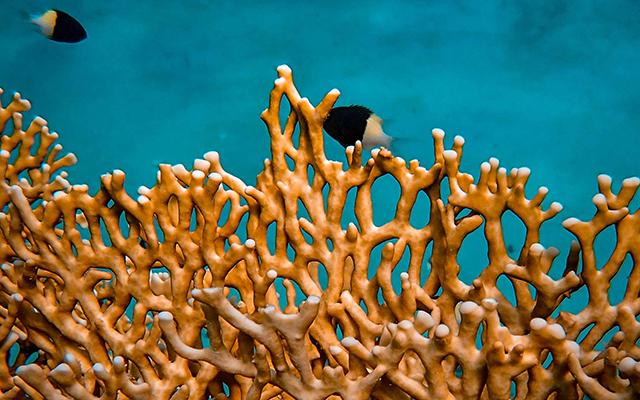
Reconstructed genomes for over 4,000 reef microbial species revealed 90% were previously unknown, and that coral microbes show high potential to produce biomedically relevant compounds. The genomes were assembled from DNA sampled in a Pacific-wide coral survey and from sequences in existing reef datasets.
Bioinformatics: from data to discovery
Bioinformatics – the science of storing, connecting, analysing and interpreting biological data – shapes lives in ways most people never see, from guiding cancer treatments to informing conservation efforts. This series highlights examples of how scientists across the SIB Network transform data into knowledge and real-world impact.
With 95% of these microbes unique to a single host – and only three reef-building coral genera sampled in the Pacific survey – the study underscores the need to protect reef ecosystems before their mostly unknown molecular diversity vanishes.
Published In Nature | SIB Group involved: Microbiome Research (ETH Zurich)
A resource for research on venomous species
The VenomsBase initiative aims to unify fragmented venom research data across species and disciplines, in an open and scalable knowledgebase. By harmonizing and integrating datasets for venomous spiders, snails, and other animals – from genomics and proteomics to functional assays and ecological metadata – the resource will accelerate discoveries in evolutionary biology, pharmacology and ecological science.
Published In Gigascience | SIB Groups involved: Evolutionary Bioinformatics (University of Lausanne) and Swiss-Prot Knowledgebases
Mobilizing siloed biodiversity data
Swiss experts highlighted the importance of biodiversity data as a strategic lever for biodiversity conservation at Bern Biodiversity Data Day 2026, organized jointly by SIB and the Swiss Academy of Sciences (SCNAT) on 21 May. Discussions focused on connecting biodiversity data at scale – across literature, field observations, genomics and analytical systems – to enable conservation decisions based on complete, usable and timely evidence. Read press release
One project presented at the event will unlock important biological information for biodiversity research and assessments. Led by SIB, the SNSF-funded collaboration is developing a modelling framework that integrates traditional species occurrence data with three currently siloed data types: genomics, traits mined from the literature, and taxonomic changes over time. Read news story
SIB Group involved: Environmental Bioinformatics
Related microbes keep similar company
A phylogenetic analysis of over 1.15 million environmental samples and nearly 183,000 microbial groups shows that closely related microbes consistently occur in similar communities. The signal holds across every phylum and environment tested – from soil to oceans – and persists across billions of years of evolution.
This ‘community conservatism’ could help refine the long-debated definition of a microbial species, by revealing biological differences that current DNA-based identification cannot. The analysis was enabled by the largest database of global microbial ecosystems, MicrobeAtlas, developed by the same SIB Group.
Published In Nature Ecology & Evolution | SIB Group involved: Bioinformatics Systems Biology (University of Zurich)
Sustainability research overlooks key actions and actors
Among 4.2 million analysed publications on achieving global sustainability, only 3.8% mention both a necessary action and an actor together. The literature analysis also revealed that actions like ‘changing social norms’ and ‘technological change’ are overrepresented in these publications, as are actors like scientists and businesses – while governance reform, civil society and the public sector are neglected. These knowledge gaps may hinder the cross-sectoral coalitions needed to address the underlying causes of biodiversity loss.
Published In Nature Sustainability | SIB Group involved: Environmental Bioinformatics
Reference(s)
Photo by Francesco Ungaro on Unsplash