
SIB scientists curate, federate and help analyse biomedical data for several large European public-private consortia that directly and indirectly address type 2 diabetes (T2D). This World Diabetes Day we highlight four insights from studies co-authored by our scientists and collaborators, and supported by such consortia.
Bioinformatics: from data to discovery
Bioinformatics – the science of storing, connecting, analysing and interpreting biological data – shapes lives in ways most people never see, from guiding cancer treatments to informing conservation efforts. This series highlights examples of how scientists across the SIB Network transform data into knowledge and real-world impact.
Age-related DNA changes could help assess T2D risk
Age is the strongest known risk factor for T2D. Yet ageing and T2D leave almost entirely different patterns of DNA methylation – chemical tags that help switch genes on or off – in insulin-producing pancreatic islets. Age-related changes act together on genes linked to insulin release, while T2D-related changes are scattered and seem to reflect cellular stress. An age-related methylation score distinguished donors with T2D better than genetic risk. Combining both could sharpen risk assessment.
Bioinformatics: from data to discovery
Bioinformatics – the science of storing, connecting, analysing and interpreting biological data – shapes lives in ways most people never see, from guiding cancer treatments to informing conservation efforts. This series highlights examples of how scientists across the SIB Network transform data into knowledge and real-world impact.
Supported by OBELISK, a European public-private partnership co-funded by the Swiss State Secretariat for Education, Research and Innovation (SERI).
See the study in Nature Communications
A potential drug to improve insulin release
Insulin-producing β cells from 13 of 21 diabetic donors regained part of their response to sugar after just three days at normal glucose levels – close to remission rates after weight-loss surgery or very low-calorie diets. The genes switched on during this recovery were similar to those switched on by baricitinib, an anti-inflammatory drug approved for arthritis. Treatment with baricitinib improved insulin release in human β cells and slowed β-cell failure in diabetic mice.
Supported by RHAPSODY, an Innovative Medicines Initiative (IMI) 2 project co-funded by SERI.
See the study in Science Advances
Urine test could flag who benefits from diabetic kidney drug
The drug atrasentan slows kidney disease in people with T2D, but some benefit more than others. In a trial of over 3,000 patients, those with more of a urine protein called clusterin had worse kidney outcomes. Six weeks of atrasentan cut clusterin levels by 43% – and the bigger the drop, the lower the risk of serious kidney decline. A clusterin test could help doctors gauge kidney risk and see early whether the drug is working.
Supported by BEAt-DKD, an IMI 2 project.
See the study in Nature Communications
Insulin signals keep the kidney’s filter cells healthy
Reducing receptors for insulin and a related growth factor, IGF1, in podocytes – the kidney cells that filter blood – caused kidney disease in mice and killed over half of lab-grown podocytes within a week. Podocytes without receptors had higher levels of faulty RNA messages and lower levels of key proteins associated with the machinery (spliceosome) that edits these messages. Furthermore, blocking the machinery killed normal podocytes but not neighbouring cells. This opens a new route to understanding podocyte loss in kidney disease.
Supported by BEAt-DKD, an IMI 2 project.
See the study in eLife
Reference(s)
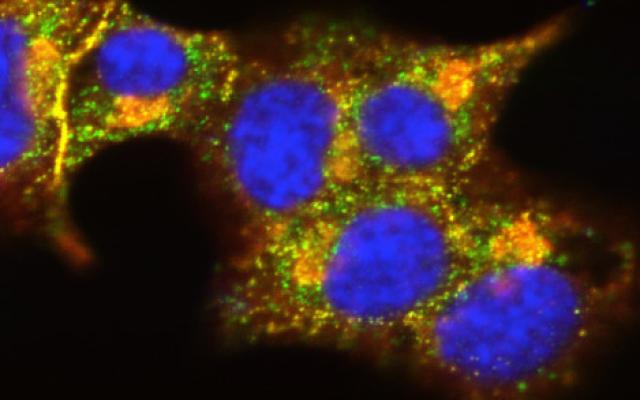
Image credit: Insulin-producing pancreatic cells. William E. Balch, The Scripps Research Institute