

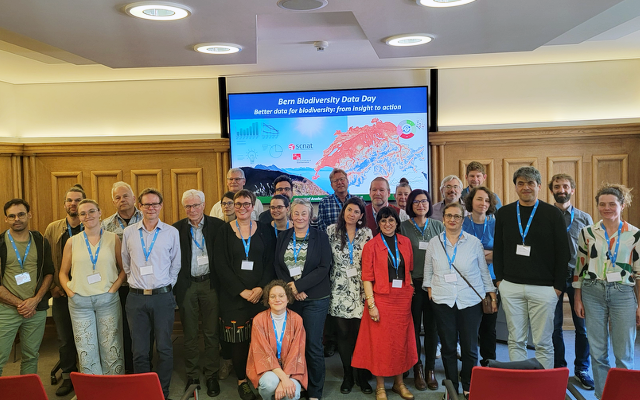
Swiss experts showcased how vast quantities of diverse linked data enable AI and other new approaches for monitoring and improving environmental health, at a high-level event in Bern. Organized jointly by SIB and Swiss Academy of Sciences (SCNAT), Bern Biodiversity Data Day brought together actors across the country’s biodiversity data chain — from natural history collections and researchers to WWF, IUCN and the Swiss Federal Office for the Environment — to further strengthen national collaborations for evidence-based ecosystem protection and sustainability. SIB scientists took this effort international this week, running workshops at the World Biodiversity Forum on connecting biodiversity data for conservation practice and policy.
Advancing data-driven biodiversity monitoring and policy
The event highlighted Switzerland’s rich flow of biodiversity, climate, land-use and other data and how these feed into each stage of national and international policy — from understanding biodiversity loss to developing, implementing and evaluating conservation actions.
New technologies are increasing this flow, by enabling more extensive field observations, rapid genetic analyses, and the liberation (i.e., FAIRification) of information locked in the scientific literature. Each year, for example, Swiss organization Plazi makes published taxonomic information on 10,000 newly described species openly available to researchers globally.
Combining these and other data types provides a more complete picture of where and how species live, and their capacity to adapt to change. Such data integration was central to two notable Swiss conservation successes, the bearded vulture and whitefish — and thanks to AI and other approaches, is now possible at far larger scales. Examples involving SIB scientists include the Biodiversity Meets Data project to monitor species and habitats across Europe in near real time, and the AI tool CAPTAIN that combines diverse variables to identify priority areas for conservation.
Strategic steps for integrated Swiss biodiversity data
Such efforts need extending to ensure the survival of other Swiss species — of which 1 in 3 are threatened, well above global estimates of 1 in 8. The event speakers and participants recommended further strengthening coordination between the country’s biodiversity data providers, data platforms and decision makers, to:
- develop standard indicators for assessing biodiversity;
- collect targeted new data, including for underrepresented species, habitats and ecosystems;
- mobilize historical data where necessary;
- harmonize and connect all data streams into an integrated, interoperable knowledgebase and monitoring system;
- improve data access, sharing and reuse through FAIR (Findable, Accessible, Interoperable and Reusable) standards and open research infrastructure.
For effective policies and actions at different scales, such efforts need to span the local, cantonal and national levels in Switzerland, and be aligned with European and global biodiversity initiatives and policies.

Switzerland would benefit from integrated biodiversity monitoring fit for multiple scales and policies.

Event speakers. Left to right: Donat Agosti (President, Plazi), Robert Waterhouse (Group Director, SIB), Eva Spehn (Scientific Collaborator, SCNAT), Jérôme Frei (Scientific Collaborator, FOEV), Alexandra Weber (Group Leader, Eawag), Daniele Silvestro (Lecturer, ETH Zurich)
Developing new tools — and the next generation of biodiversity experts
Speakers from the SIB Network and partners Plazi and Eawag showcased innovative technologies for large-scale generation and analysis of biodiversity data, including to:
- further liberate biodiversity knowledge from research publications;
- monitor biodiversity and model future changes at the European scale using Virtual Research Environments;
- monitor invasive quagga mussels using whole-genome sequencing data;
- improve biodiversity assessments by integrating previously siloed data into models of species richness and distribution;
- strengthen AI-enabled conservation planning, including to the Swiss cantonal level.
Human expertise remains essential, however. Participants noted, for example, that AI models require human feedback for fine-tuning, while crucial field studies can only be done by people.
To ensure Switzerland’s continued biodiversity expertise and capacity, speakers and participants recommended strengthened training and professional development — including ensuring younger biologists and volunteers are equipped with the necessary skills for the future.
Extending Switzerland's biodiversity expertise internationally
At the World Biodiversity Forum this week, SIB scientists and partners ran two workshops to further evidence-based biodiversity policies and actions at the global level: one on developing genomics‑enabled indicators for biodiversity targets, and the other on establishing a new Community of Practice to streamline the liberation of biodiversity knowledge from the literature.

Switzerland is well positioned to transform biodiversity data into insights and actions at the national and international level, thanks to highly skilled field biologists, researchers and data scientists working within a collaborative ecosystem of academic, non-profit and governmental institutions.
Speaker and participant institutions:
- Eastern Switzerland University of Applied Sciences
- ETH Zurich
- Geneva Botanic Garden
- Global Biodiversity Information Facility (GBIF) Switzerland
- Infofauna
- IUCN
- Plazi
- SIB
- Swiss Federal Institute for Forest, Snow and Landscape Research
- Swiss Federal Institute of Aquatic Science and Technology (Eawag)
- Swiss Federal Office for the Environment
- Swiss Natural History Collections Network (SwissCollNet)
- Swiss Ornithological Institute
- University of Bern
- University of Fribourg
- University of Lausanne
- University of Neuchâtel
- Vaud museums
- WWF Switzerland
Reference(s)
Image credit: Eva Sphen – SCNAT