

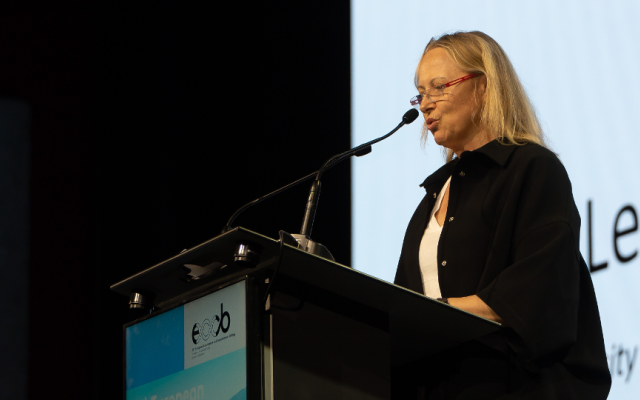
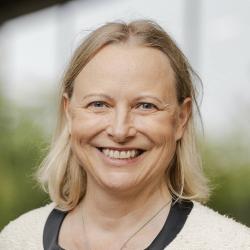
In her opening address to the European Conference on Computational Biology (ECCB), University of Geneva Rector Audrey Leuba spoke on what makes data scientifically valuable.
Transcript below
Ladies and gentlemen, all protocols observed,
It is a great pleasure to welcome you to Geneva, and to see researchers from so many countries and disciplines come together to reflect on the future of computational biology.
I would like to begin with a simple question – but one that I believe is becoming fundamental to science: what makes data scientifically valuable?
We are living through an extraordinary transformation of research. Our ability to generate, collect and analyse biological and biomedical data is growing at an unprecedented pace. At the same time, artificial intelligence and increasingly powerful computational methods are opening entirely new possibilities for scientific discovery.
Data do not become knowledge simply because they are abundant. They become a scientific resource when they are reliable, carefully curated, properly documented, interoperable and reusable – and when their provenance and limitations can be understood.
Yet all of this ultimately depends on something more fundamental: the quality of the data.
Data do not become knowledge simply because they are abundant. They become a scientific resource when they are reliable, carefully curated, properly documented, interoperable and reusable – and when their provenance and limitations can be understood. The quality of data is therefore inseparable from the quality of science.
This principle has a particular resonance at the University of Geneva. Our university has a long-standing tradition in computational biology. In 1986, Amos Bairoch, then a PhD student at the University of Geneva, created Swiss-Prot. What began as a pioneering initiative grew into a global scientific resource and ultimately became part of UniProt Knowledgebase.
That pioneering spirit is continued today, with our researchers contributing to leading biological data resources worldwide. This legacy also reflects a broader ambition that we share with the Swiss Institute of Bioinformatics: to foster trusted scientific data and reinforce Geneva’s leadership in this field. The Datarium exhibition is a tangible expression of this shared ambition – and of what we can achieve together.
But this experience also points to a broader challenge. The question of data quality is no longer specific to biological databases. Across every field of research, we need to consider not only how data are produced and analysed, but also how they are interpreted, shared and reused. This becomes particularly important as research grows more collaborative – and more dependent on computational methods and artificial intelligence.
For universities, this is not simply a technical question. It is a question of academic quality. And it is a question of scientific responsibility. We have a responsibility to ensure that research data can be understood, reproduced and responsibly reused. And we have a responsibility to train researchers who understand where data come from, what their limitations are, and how they can responsibly be shared and reused.
This is why Open Science and responsible research data management are becoming integral to our research mission. We should make data as open as possible, while protecting them where necessary. And we must ensure that openness always goes hand in hand with rigour and responsibility.
And this brings us back to the question with which I began: What makes data scientifically valuable?
Not simply their quantity. Not simply the power of the tools we use to analyse them. But our ability to turn them into knowledge that can be trusted, shared and built upon. This is where the role of the university is essential: to combine innovation with the values that make science possible – curiosity, rigour, reproducibility, collaboration and trust.
At the University of Geneva, this is the research culture we seek to foster: open, rigorous, international and collaborative.
Ultimately, the extraordinary possibilities offered by data and computation must serve what remains at the heart of our mission: to produce knowledge that can be trusted, shared and advanced collectively.
I wish you a stimulating conference – and an amazing stay in Geneva.
Thank you.


