

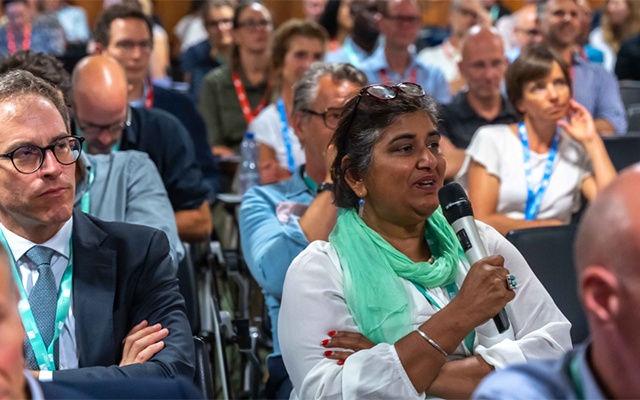
How can data help personalize cancer treatment, track epidemics and protect biodiversity? And as AI becomes increasingly prevalent, how can Switzerland combine innovation with responsible data use and digital sovereignty? These questions brought a hundred citizens, scientists and policymakers together in Geneva for a public forum organized by SIB as part of #GenevaLovesData and the opening day of ECCB 2026. Through scientific talks, hands-on workshops and a policy debate, the event brought the often-invisible data behind science into public view – and highlighted the expertise and infrastructure needed to turn them into benefits for society.
Making the invisible foundations of science visible
Scientists have become extraordinarily good at producing data on life, from reading a human genome and measuring a cell’s activity to monitoring entire ecosystems. But producing data is only the beginning. To generate knowledge, the data need to be understood, organized, connected and made reusable – work that requires scientific expertise, common standards and sustainable infrastructure. This is a core role of bioinformatics.
The public forum opened the discussion from three perspectives.
- SIB President and Swiss National Councillor Simone de Montmollin addressed the scientific and political responsibility for ensuring that data are reliable, documented, secure and usable over time.
- Geneva University Hospitals (HUG) Director General Robert Mardini highlighted the importance of international cooperation – particularly in areas where no single institution or country can generate all the data needed for robust science, such as rare diseases, precision oncology and epidemic surveillance.
- SIB Executive Director Christophe Dessimoz explored how bioinformatics transforms rapidly growing volumes of biological data into knowledge – and why this capability is even more important with AI.
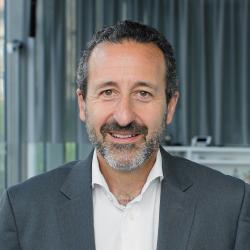
International cooperation remains the lever for improving [data] quality, diversity, and scientific reach.
From monitoring cancer and epidemics to entire ecosystems
Four scientists based in Geneva then showed what bioinformatics means in practice at different scales, along with ethical questions around using and sharing sensitive data.
- Precision oncology: Olivier Michielin showed how combining patient, tumour and clinical trial data with AI and other computational tools can surface new therapeutic options generally and for individual cancer patients. One example is process mining, which maps the real sequence of treatments and scans each patient goes through to identify which care pathways give patients the best outcomes. Michielin heads the Department of Oncology and the Precision Oncology Service at Geneva University Hospitals (HUG), is a professor at EPFL, and is an SIB Group Leader.
- Epidemic preparedness: Valérie Barbié explained how pathogens are tracked across populations and countries in real-time, from traces of their genetic materials in wastewater and other sources. SIB scientists enable this surveillance in Switzerland, by collecting pathogen genomic data from around the country through the Swiss Pathogen Surveillance Platform, analysing these data, and providing actionable insights to the Federal Office of Public Health. Barbié is Director of SIB’s Clinical Bioinformatics Department.
- Environmental protection: Pascal Peduzzi showed how climate, biodiversity, satellite imagery and other environmental data reveal the state of Earth’s ecosystems today and where they are heading. GRID-Geneva transforms such data into evidence that policy makers can act on, and can also use the data to assess whether environmental policies are working. Peduzzi is Director of GRID-Geneva and a professor at the University of Geneva.
- Data ethics: Samia Hurst explored what it takes to earn patient trust when medical data are used for research. Factors include robust anonymization, patient choice and control in the use of their personal data, and who is asking to use the data. Hurst is Director of the Institute for Ethics History and Humanities (iEH2) and the Department of Health and Community Medicine at the University of Geneva, and a consultant for the HUG’s Clinical Ethics Committee.
Together, the examples illustrated a common principle: the value of data lies not simply in the quantity collected, but in whether they are sufficiently reliable, accessible and connected to generate knowledge and support decisions. This is particularly important for AI: powerful algorithms cannot compensate for incomplete, poorly documented or biased underlying data.
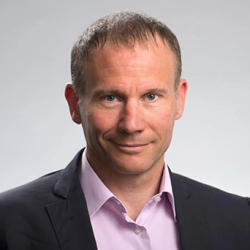
We are able to prioritize therapeutic options for patients with cancers that fail to respond to standard treatments, thanks to the high-quality data available in the HUG, University of Geneva, and Switzerland more broadly, notably through the Swiss Personalized Health Network.
Between sessions, participants got hands-on with real biological data: analysing DNA sequences, exploring genetic variations and manipulating 3D protein structures. The interactive activities, which SIB also runs regularly for high-school students, gave a direct sense of how bioinformaticians work with complex life-science data to investigate concrete biological and medical questions.
The Datarium exhibition extended this practical exploration with real-world examples from Swiss research, illustrating concrete applications in health, environmental protection and AI.
Responsible AI, data sovereignty and global competition
The forum concluded by moving from science to strategy: how can Switzerland and Europe remain competitive in the global AI race while ensuring responsible data use and preserving the ability to act independently?
Yves Flückiger, President of the Swiss Academies of Arts and Sciences, moderated a round table bringing together cantonal, federal and academic perspectives from:
- Delphine Bachmann, State Councillor, Department of Economy, Employment and Energy, Canton of Geneva;
- Laetitia Philippe, Deputy Director, Head of the National Research and Innovation Division, Swiss State Secretariat for Education, Research and Innovation (SERI);
- Antoine Geissbühler, Faculty of Medicine Dean, University of Geneva, and Director of Teaching and Research, HUG.
Four messages emerged from the discussion:
- trust, quality and security need not constrain innovation, but rather can strengthen competitiveness;
- data sovereignty does not mean doing everything nationally, but instead retaining the capacity to choose critical partners, infrastructure and dependencies;
- Switzerland cannot compete internationally through scale alone, but can build on scientific excellence, talent, strong institutions and trust in strategically important areas;
- Geneva offers a unique environment where science, government, international organizations and innovation coexist.
The discussion further reinforced that realizing the benefits of AI requires not simply computing power, but also reliable data, skilled people – and the research infrastructure that connects the two. SIB is strongly committed to this, as a provider of high-quality biodata, world-class data infrastructure, and training to build the necessary expertise to use these.

Producing and enriching data strengthens Switzerland's digital sovereignty and helps keep the country among the world's most innovative and competitive economies.
Taking data science beyond the laboratory
The forum reflected a central ambition of #GenevaLovesData: to bring the importance of biological data outside the scientific community and create dialogue between scientists, citizens and decision-makers.
Together with Datarium and ECCB 2026, it highlighted the value of high-quality data – and the expertise and infrastructure Switzerland needs to turn these into advances in research, innovation and trustworthy AI.
Reference(s)
Image credit: Gonzalo Bell | SIB


