

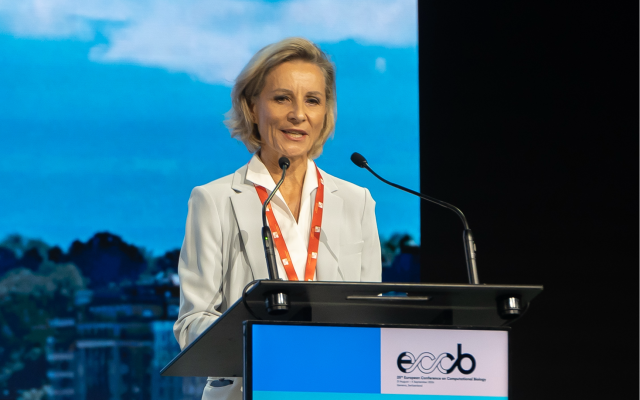
In her opening address to the European Conference on Computational Biology (ECCB) in Geneva, SIB President and Swiss National Councillor Simone de Montmollin spoke on how reliable data underpin sound democratic decisions, and the role of Geneva as a global hub for trusted scientific data.
Transcript below
Mr President of the Swiss Confederation, Madam President of the State Council of Geneva, Madam Rector, distinguished guests, ladies and gentlemen,
It is a great honour, as President of SIB, to welcome you to Geneva for the 25th European Conference on Computational Biology – and a genuine pleasure to see such an international scientific community gathered here for the first time.
Geneva is not simply our host city. It is a place shaped by science, cooperation and openness to the world. Here, states negotiate across their differences; international organizations turn knowledge into common action; and institutions such as the WHO, CERN, the United Nations, our universities and hospitals connect research, policy and society. Geneva is a place where standards are discussed and trust is built across borders. That makes it the right place for our conversation today.
And Geneva loves data.
Science cannot make democratic choices for us. But democracy cannot make sound choices without science.
That is more than the name of our public programme. It expresses a conviction: data science must not remain confined to laboratories. Through the Datarium exhibition – online, outdoors and here inside the CICG – biological and biomedical data become visible and understandable. Many secondary-school classes have already visited it. The next generation should not only use data-driven technologies; it should understand the evidence and responsibilities behind them.
Our societies face intertwined challenges: ageing populations, emerging pathogens, biodiversity loss, pressure on food systems and artificial intelligence. Science cannot make democratic choices for us. But democracy cannot make sound choices without science. Reliable knowledge helps us distinguish evidence from assertion, uncertainty from manipulation, and progress from mere promise. In an age of disinformation, this is part of the infrastructure of democracy itself.
As a member of the Swiss Parliament, I see a further dimension. Data are now a matter of sovereignty, security and credibility. Sovereignty means retaining the capacity to understand, decide and act – not withdrawing from cooperation. Security means protecting sensitive information while keeping vital data and expertise available in a crisis. Credibility means that a public decision, scientific result or AI system can be traced back to evidence we trust.
So what is a high-quality dataset? Is it accurate and secure? Open where possible, protected where necessary? Is it documented, interoperable, verifiable and representative? Can it be reused responsibly – and will it still be intelligible ten years from now? Quality is not a label applied at the end. It is a chain of stewardship, from collection and curation to long-term preservation.
We must also ask what the technology is for. More computation is not automatically more progress. Innovation has meaning when it improves health, protects our environment and serves human dignity. The question is not only what we can build from data, but what we should build – and for whose benefit.
This requires a framework that protects rights without paralyzing research; sustainable infrastructures; and the people who make data reliable. This is precisely the role of institutions such as SIB: to provide trusted resources, expertise and continuity beyond individual projects.
And because data cross borders, standards and rules must do so as well. Harmonization has never been more necessary. Geneva can become a global hub for trusted scientific data – a place where science, policy and international cooperation shape rules worthy of public confidence.
This week, you will advance the science. My hope is that, together, we will also advance the trust on which its impact depends.
I wish you an inspiring conference and a wonderful stay in Geneva. Thank you.
Reference(s)
Photos:
Gonzalo Bell
Valentin Luggen


