

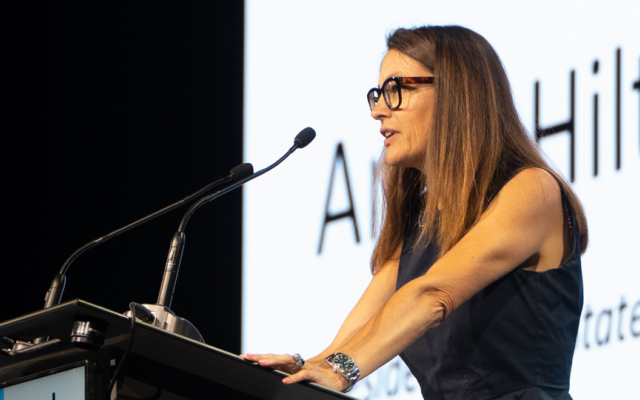
In her opening address to the European Conference on Computational Biology (ECCB), the President of the Republic and Canton of the Geneva State Council, Anne Hiltpold, spoke on the importance of data and bioinformatics to society and Geneva's commitment to science.
Transcript below
Mr. President, Mrs. Director, Mrs. President, ladies and gentlemen,
At some point, it was said that information and data were the oil of the twenty-first century. It may have been right… at some point. It is not right anymore.
In the past, data were mainly stored. The production of statistics and analyses on their basis was time-consuming. Data were used to interpret the present. Nowadays, data circulate rapidly and permanently. They are being analysed live. They are used to predict the future. Today, information and data are not only extracted resources. They are the engine of our everyday lives.
But similarly to oil… raw data still have absolutely no value on their own. They need to be transformed. And they need to be transformed with ethical and human perspectives. Yes, the power of innovation shall be balanced with the protection of the private life and the common good.
Bioinformatics ... transforms raw data into useful knowledge. It allows us to better understand living organisms and to guide decision-making.
Ladies and Gentlemen, on behalf of the Geneva State Council, I would like to say a sincere thanks for your invitation. It is an honour to join you today.
As humans, nowadays, we face more complex challenges than ever before. We live in an interdependent world. What happens in the South has an impact in the North. What happens in the East has an impact in the West. The challenges are global. They do not know any border. When a new virus emerges in a remote region of a distant country, soon it becomes a threat for the whole humanity. Climate change, poor harvests and drought continue to push human waves to poverty, misery, migration.
The challenges are huge. But science and technology have recently made progresses at an extremely high pace.
The exhibition Datarium, which was visible at the Parc des Bastions and is still visible at the Rotonde du Mont-Blanc, shows it. Data is just a piece of information. It is a medical image. It is the temperature of a lake. It is a DNA sequence. On its own, it tells us very little, like a single piece of a jigsaw puzzle. Bioinformatics enables us to organise, link and analyse millions of pieces together. It transforms raw data into useful knowledge. It allows us to better understand living organisms and to guide decision-making.
Data lies at the heart of infectious diseases. It enables personalised care. It helps to better protect biodiversity. Yes, technological and scientific developments offer opportunities. But once again, we shall all be careful that they are being used for the well-being of the whole humanity.
Ladies and Gentlemen, computational biology lies at the interface of several disciplines, enabling the analysis of complex biological data. It transforms vast volumes of data into actionable knowledge.
Geneva is proud to be a global hub and a centre of excellence in the processing of biological data. It is proud to be a driving force behind the growth of computational biology. I would like to here to underline the fantastic work of institutions such as SIB, the University of Geneva and the Hôpitaux Universitaires de Genève.
To be able to face the challenges of our era, the one and only way is cooperation. Cooperation between countries, through multilateralism. Cooperation between the public and private sectors. Cooperation between science and diplomacy.
As you probably all know, the Canton of Geneva has had a strong relationship with science and diplomacy. And we are committed to strengthen this relationship now and in the future. We are convinced that in order to progress, in order to promote truth and to fight fake news and conspiracy theories, we need more science. We need more proof. We need more facts. We also need more explanations. More exchanges. More connexions.
Therefore I wish you great moments of exchange, here in Geneva!
Reference(s)
Photos: Gonzalo Bell


