

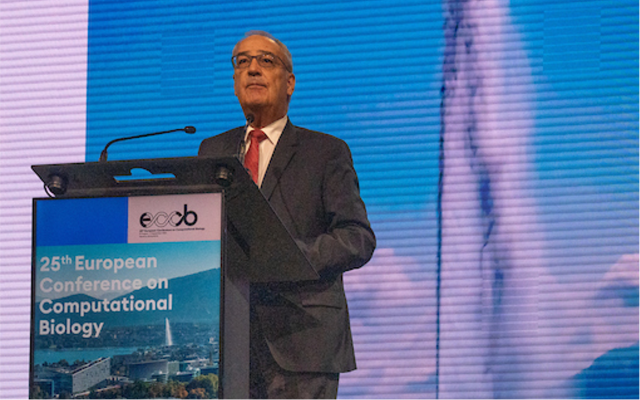
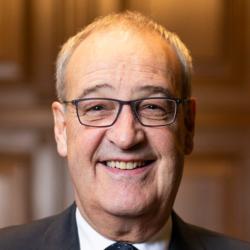
In his opening address to the European Conference on Computational Biology (ECCB) in Geneva, Guy Parmelin spoke on how the field is contributing to Swiss digital sovereignty, responsible AI – and the transformation of knowledge into progress, power into responsibility and innovation into trust.
Transcript below
Madam President of the State Council, Madam President of SIB, Madam Rector, Director, ladies and gentlemen,
We can now read living systems at a scale that would have been unimaginable a generation ago. But the more legible life becomes, the more complex the questions become.
Computational biology sits precisely on this frontier, as the theme of the 25th ECCB makes clear. We need to better prevent and treat disease. To understand biological mechanisms at unprecedented complexity. To anticipate how pathogens evolve. To document the erosion of biodiversity. And, in each of these areas, to turn volumes of data into reliable knowledge – and that knowledge into responsible decisions.
[Computational biology] forces us to think about data, models, computing power, infrastructure and standards, reproducibility and, last but not least, trust – all at the same time.
Computational biology has become indispensable. It links genomics to medicine. It brings structural biology closer to drug discovery. It makes it possible to integrate multi-omics data, model complex systems, monitor pathogens and understand ecosystems better. But its importance goes beyond its applications. It is changing the very way we do science. It forces us to think about data, models, computing power, infrastructure and standards, reproducibility and, last but not least, trust – all at the same time.
For Switzerland, this transformation is both an opportunity and a responsibility. Our country holds a leading scientific position. It owes this to the quality of its higher education institutions, to the ETH domain institutions, its university hospitals, its research centres and institutions like SIB, whose expertise shines well beyond our borders.
But scientific excellence is never a given. It has to be built and constantly maintained. It depends on the talent we train day after day, and the talent we attract.
Our international openness and the freedom research enjoys in Switzerland are also key factors, as is our capacity to produce, share, secure and interpret high-quality data. That is why the Confederation invests in research and data infrastructure. The Swiss Personalized Health Network is one example. Together with hospitals, higher education institutions and SIB, it has helped build a national infrastructure that makes health data interoperable and usable for research, within a demanding framework of security, governance and protection of individuals.
The Swiss National Supercomputing Centre in Lugano is another. With the Alps supercomputer, Switzerland now has computing infrastructure of the highest level. Alps is where Apertus was trained, the fully open large language model developed under the Swiss AI Initiative.
What is at stake, though, goes beyond computing power. In a technology sector marked by the concentration of capacity, Switzerland must retain the means to understand the technologies it depends on, to develop them, to scrutinize them and, where necessary, to adapt them to its own needs. That is how I see digital sovereignty: not as withdrawal, but as the ability to act sovereignly in an interdependent world.
Artificial intelligence makes the question more pressing still, because it can detect patterns in volumes of data that no human mind could explore alone. It can speed up the formulation of hypotheses, improve certain predictive models and bring unexpected connections to light. But it removes neither uncertainty, nor judgement, nor responsibility.
Data can be abundant without being representative. A model can perform well without being explainable. A prediction can be statistically sound and still not be enough to base a decision on. And an optimization can be technically remarkable while pursuing a goal we should perhaps never have chosen. That is why the place of the human being remains central. Not because people should be doing what machines do better. But because no algorithm can legitimately determine, in our place, what ends a society should pursue. Artificial intelligence cannot dictate our choices.
This point is critical in health. Behind every set of data there is a person. Every genome sequence tells a biological story. Every clinical decision involves a patient. The distinction is fundamental for biodiversity too. Models can show us what we stand to lose. They can shed light on the consequences of our decisions. But they cannot decide in our place what we want to preserve, or what responsibility we want to take towards future generations.
The trust I mentioned earlier thus becomes infrastructure as essential as data centres or supercomputers. It requires technologies that are reliable, transparent and open to scientific scrutiny. It requires shared standards, rigorous data governance and the ability to verify results. It also requires constant dialogue between scientists, doctors, engineers, policymakers and public institutions.
That is exactly the value of a conference like ECCB. For a few days, Geneva, our international city, brings together disciplines, institutions and countries around a single imperative: to advance knowledge by testing results against each other, by sharing ideas, and by cooperating. This scientific culture of exchange matters particularly today. No nation, institution or discipline can, on its own, meet the challenges that ECCB is addressing.
We are entering an era in which our capacity to observe, model and transform living systems is advancing at phenomenal speed. That power opens immense prospects – and places demands on us to match. This is where our ability to turn knowledge into progress, power into responsibility and innovation into trust comes into play.
The challenge, in short, is not measured in volumes of data, computing speed or model accuracy. The challenge is a human one, a reminder of the timeless value of Rabelais's old adage: "Science without conscience is but the ruin of the soul."
Thank you for including me in this opening ceremony. I wish this 25th conference every success.
Reference(s)
Photos:
Nicolas Righetti | lundi 13
Raphael Moser


